 Activix
  AutoTrader
  Black Book
  CarGurus
  Equifax
  TransUnion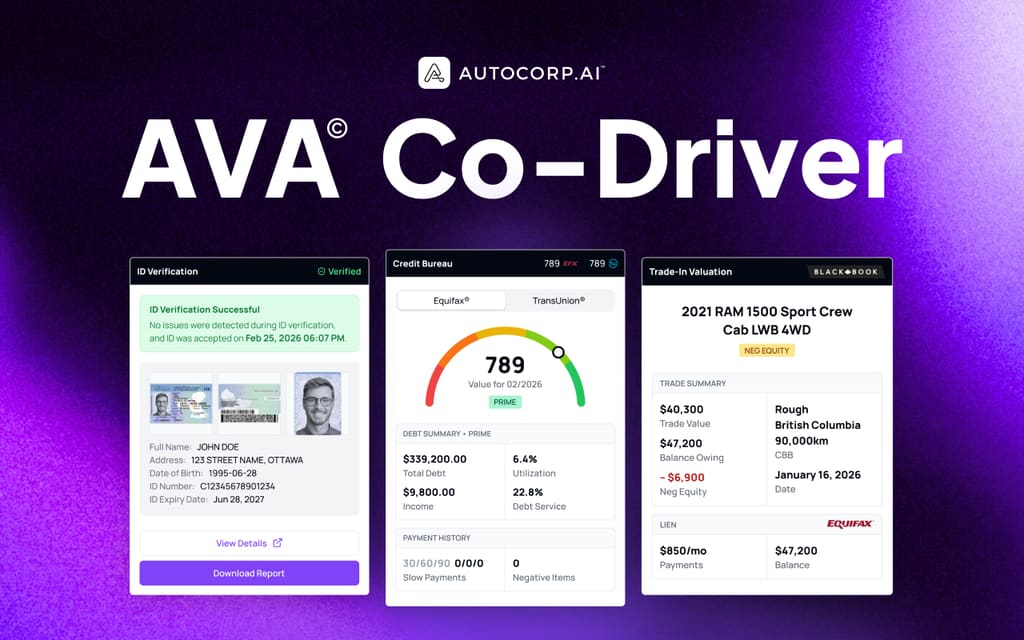



Texting is the highest-open-rate channel your dealership has. Response times are measured in minutes, not hours, and customers already expect it. But most dealership texting programs quietly underperform for one reason: the messages don't ask the customer to do anything meaningful. A "just checking in" text gets a polite reply. A text with a no-impact credit link gets a lead you can actually work.
In our experience helping 650+ dealerships build SMS programs on the AVA® platform, there are 4 things Sales and Ops Managers need to get right when texting customers:
1. Every text should move the deal forward, not just the conversation
If your SMS is a generic drip ("Hey, thinking about that Silverado?"), you're competing with every other dealer sending the same thing. The customer replies "still looking," and you're back where you started. To move a deal forward, a text has to ask the customer to do something that qualifies them, book a test drive, verify their trade, or run a soft credit pull. The message needs a purpose beyond touching base.
2. Credit context beats generic follow-up every time
From our experience working with dealers running AVA® Campaigns, texts that include a no-impact credit link generate 3-4x more responses than plain-text follow-ups. A good dealership SMS platform should let you send a soft-pull Equifax link right inside the text, so the customer can qualify themselves in 60 seconds without walking into the store. That single change turns "no reply" into a scored lead with a credit tier attached.
3. Templates and consent aren't optional. They're the operating system.
Most dealerships still text from personal cell phones, which means conversations aren't tracked, managers can't coach, and when a salesperson quits, the customer relationship walks out the door. A good SMS platform should route every text through a dealership-owned number, log every message in a conversation hub, and enforce opt-in and STOP compliance automatically. Otherwise you're one CRTC or TCPA complaint away from a fine.
4. You should be able to prove SMS drives revenue, not just replies
Yes, this post is about texting. But a good campaign platform should also tie every SMS conversation back to leads created, appointments booked, trades submitted, credit apps started, and units sold. Why? Because a 34% reply rate means nothing if none of those replies become deals. Now, you may wonder, can't I just check my CRM? You can, but the data lives in three tools, and the numbers rarely match. Keeping the SMS builder, conversation hub, credit link, and results dashboard in one platform removes the reconciliation work.
After watching dealers waste 20+ hours a month on manual follow-up that never converts, we built AVA® Campaigns, an SMS platform designed around credit qualification. In this post, we'll walk through the do's and don'ts through the lens of all four factors above, and show you what a credit-first SMS strategy actually looks like in practice.
Key Takeaways
- The biggest do: send SMS with a no-impact credit qualification link, not a generic "checking in" message. Credit-link campaigns in AVA® consistently generate 60+ leads per send versus a handful from plain-text drips.
- The biggest don't: text customers without credit or deal context. It trains them to ignore you.
- Keep every message short (under 160 characters), route it through a dealership-owned number, and use templates so your team stays consistent.
- Always collect opt-in consent, honor STOP replies automatically, and never text from a personal cell phone.
- Measure SMS by leads created, appointments, trades, and credit apps, not just reply rate.
Do #1: Send Credit Qualification Links, Not "Just Checking In" Texts
The biggest do (and the one that separates real SMS programs from noise)
Most dealership texts fail because they ask nothing of the customer. "Hi Sarah, still thinking about the Rogue?" gets a shrug. A message with a no-impact Equifax link gets a decision.
Here's how it works in AVA® Campaigns. You build the SMS in the campaign builder, drop in a trackable credit qualification link, and send it to a segmented list (aged leads, unsold showroom traffic, service customers with equity, whatever fits the play). The link opens the same 4-step credit form your website uses. The customer completes it in about 60 seconds, and the lead lands in your portal with a credit tier, score range, and Equifax data attached.
For example, say your BDC wants to re-engage 300 aged leads from Q3. Instead of a generic "we have new inventory" blast, they send:
"Hi Sarah, it's Mike at [Dealership]. Curious what you'd qualify for on a new Rogue? Check in 60 sec, no impact to your credit: [link] Reply STOP to opt out."
That single send, in our customers' data, routinely produces 60+ credit-qualified leads, along with the trade-in info and Equifax score range attached. Compare that to a plain-text drip on the same list, which usually returns a handful of "still looking" replies and zero qualified leads.
The reason it works is simple: you're giving the customer a low-friction, low-risk action (no credit impact, no salesperson call, no showroom visit), and the ones who complete it are self-selecting into "ready to shop."
Don't #1: Text Without Credit or Deal Context
The mirror image of the do above. If your SMS doesn't include a link to qualify, book, or verify something, ask yourself why you're sending it. Every generic text you send trains the customer to skim past your number the next time.
Bad text:
"Hey Sarah, just wanted to touch base and see if you had any questions!"
Better text:
"Hi Sarah, Mike at [Dealership]. New '24 Rogues just landed and lender rates dropped this week. See what you'd qualify for in 60 sec, no credit impact: [link]"
The second one gives Sarah a reason to click today. The first gives her a reason to reply "no thanks."
Do #2: Use Templates and a Dealership-Owned Number (Saving You 15+ Hours a Week)
Consistency is what makes SMS scale past one salesperson
Every dealership we onboard has at least one salesperson who's "great at texting." The problem is that when they leave, their customer relationships leave with them, because they were texting from a personal cell.
AVA® lets shoppers check credit and trade value in seconds, with no score impact. See how it feels.
AVA® Campaigns solves this two ways. First, every text goes through a dealership-owned number tied to your account. Second, the built-in template library lets your team send the right message for the right stage: first contact, appointment confirmation, no-show follow-up, credit-qualified follow-up, trade appraisal ready, and so on. Salespeople personalize the first line, but the CTA and compliance language stay consistent.
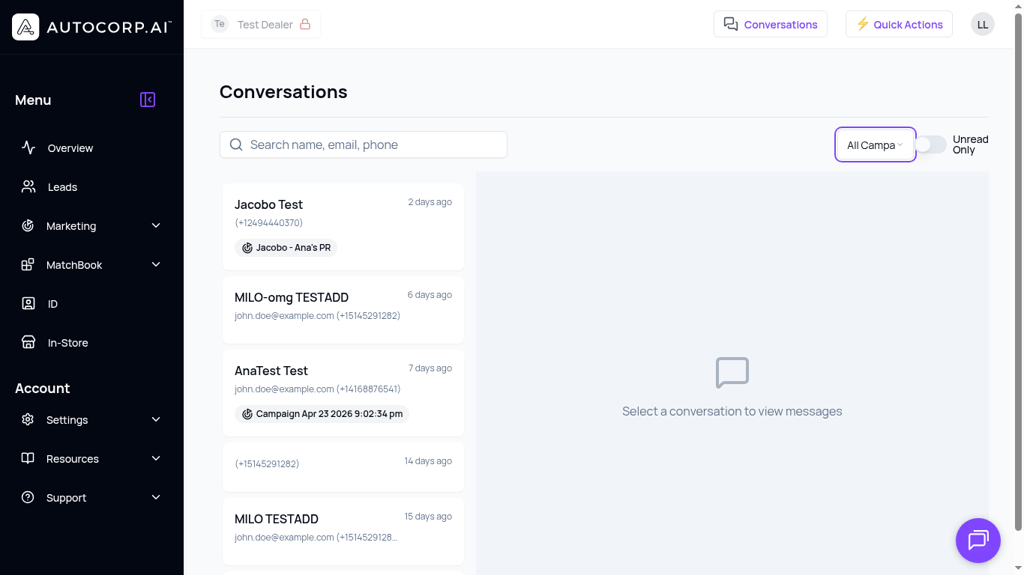
Every conversation, no matter which rep sent it, lives in the shared Conversations hub. Managers can search by name, email, or phone, filter by campaign, and coach reps on real threads. When a rep quits, the customer stays with the store.
Don't #2: Text From Personal Cell Phones
This is the mistake we see most often, and it's the one with the highest hidden cost.
When your team texts from personal phones:
- Conversations aren't logged in your CRM or your SMS platform
- Managers can't review tone, compliance, or missed opportunities
- STOP requests aren't tracked, which is a real CRTC/TCPA problem
- The customer's phone number, context, and history walk out the door when the rep does
We've had dealers discover, after a rep left, that 40% of their pipeline was sitting in an iMessage thread no one else could see. Don't let that be your store.
Do #3: Get Explicit Opt-In and Honor STOP (All Inside AVA®, Without Bolting on a Compliance Tool)
The compliance piece most dealers get wrong until they get a complaint
Every SMS campaign you send needs documented consent. In Canada, that's CASL. In the US, that's TCPA. Both regulators are actively enforcing, and dealership SMS is on their radar.
The way AVA® Campaigns handles this is simple. Consent is collected at the point of lead capture, whether that's your website credit form, an in-store QR code, or a manual lead entry. The opt-in language and timestamp are stored with the lead record. Every outbound campaign automatically appends the required disclosures ("Msg & data rates may apply. Reply STOP to opt out. HELP for help.") and honors STOP replies platform-wide, not just for one campaign.
If a customer texts STOP once, they're removed from every future campaign across your account. You don't have to remember. The system does it.

Don't #3: Send Unsolicited Blasts or Ignore STOP Replies
A few things that will get your dealership in trouble fast:
- Uploading a purchased list and blasting it (never do this)
- Texting a lead who checked "email only" on your web form
- Continuing to send campaigns to a number that replied STOP
- Sending marketing SMS outside of permitted hours in the customer's timezone
Every one of these is a CASL/TCPA violation, and the fines are per-message. The upside of doing it right: customers who opt in and stay opted in reply at 34%+, which is what our campaign data across live dealerships shows.
Do #4: Measure SMS by Deals, Not Just Replies (Without Needing to Export Data)
The metric that actually matters
A 34% reply rate on your SMS campaigns is a nice number to put in a slide. It doesn't tell you if the program is making money.
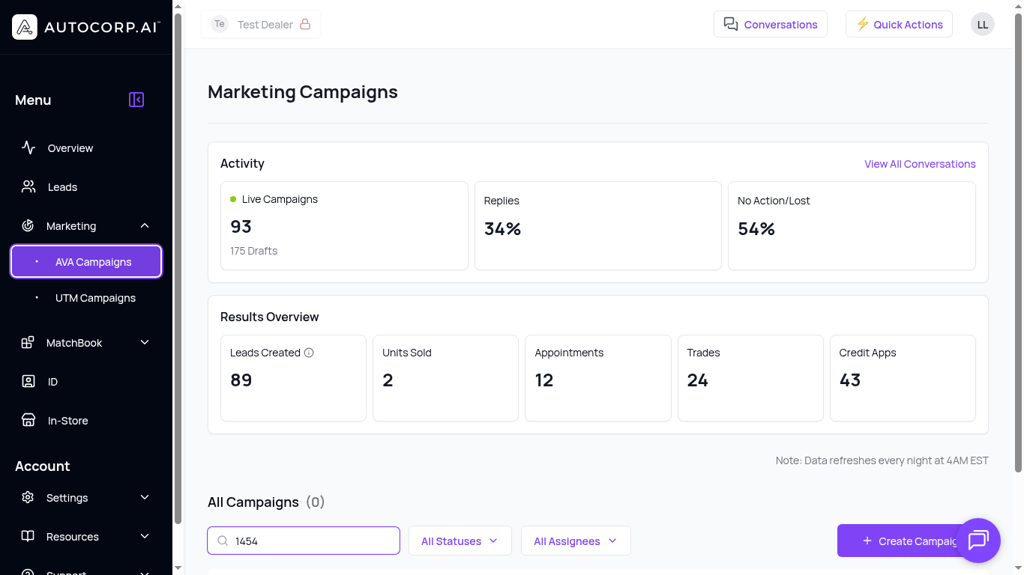
The AVA® Campaigns dashboard shows the full funnel in one place: Live Campaigns, Replies %, No Action/Lost %, and then the outcomes that matter, Leads Created, Units Sold, Appointments, Trades, and Credit Apps. In a recent snapshot from one of our dealer accounts, 93 live campaigns drove 89 leads created, 43 credit apps, 24 trades, 12 appointments, and 2 units sold in a single reporting window, all tied back to the specific SMS sends that produced them.
Now, you may wonder, can't I just pull this from my CRM? You can try. But if you're running SMS in one tool, credit in another, and trades in a third, the numbers never reconcile. Half your credit apps show up as "unknown source." That's how dealers end up killing SMS programs that are actually working, because they can't prove it.
Keeping the SMS builder, the credit link, the trade tool, the conversation hub, and the results dashboard in one platform means you can look at any campaign and see: this send produced 62 credit apps, 8 of those turned into appointments, 3 sold. That's the number that decides whether SMS gets more budget next month.
Don't #4: Judge SMS by Open Rate Alone
Open rate is nearly meaningless for SMS (it's always 95%+). Reply rate is a better signal but still doesn't pay the bills. The metrics that should drive your SMS strategy:
- Credit apps started per 100 sends
- Appointments booked per 100 sends
- Units sold per campaign
- Cost per credit-qualified lead
If your current SMS tool can't answer those questions, it's a texting tool, not a sales tool.
See What a Credit-First SMS Strategy Looks Like
The dealerships getting real results from texting aren't sending more messages. They're sending smarter ones, anchored to a no-impact credit link, routed through a dealership-owned number, and tracked all the way to units sold.
If you want to see how AVA® Campaigns builds credit-qualified SMS sends in a few clicks, book a demo and we'll walk you through a live campaign on your own data. Or, if you're earlier in your research, check out our Marketing Tools for Dealerships page and our pricing plans to see which tier includes advanced SMS campaigns and equity mining.


